The Problem Behind the Problem


Most of the time, we see the problem before we see the system around it.
A team is not communicating. A leader is overwhelmed. Two departments keep blaming each other. Decisions are delayed. Someone is resisting change. A good employee suddenly becomes disengaged. A business keeps facing the same obstacle, even after trying several different solutions.
So we focus on the problem we can see.
We try to fix the communication. We talk to the difficult person. We change the process. We introduce a new strategy. We have another meeting.
And sometimes it works.
But sometimes, after all the effort, the problem returns in a slightly different form.
This is where I become curious.
What if the problem we can see is only a symptom of something else?
A visible problem can be connected to relationships, roles, expectations, history, power, belonging, or patterns that have developed over time.
The person who seems resistant may not be the source of the problem.
The team that seems difficult may not be the real issue.
The leader who cannot let go may be responding to something in the organization that makes letting go almost impossible.
And the conflict between two people may have very little to do with the conversation they are currently having.
Sometimes, the most interesting part of a problem is not what is happening, but what keeps making it happen.
Think about a team that repeatedly struggles with the same decision.
Every few months, they have the same discussion. Everyone agrees that something needs to change. A decision is made. People leave the meeting with good intentions.
And then nothing really changes.
The usual response is to have another conversation.
But what if the real question is not:
“Why can't they make a decision?”
What if it is:
“What is happening in the system around decision-making?”
That small shift can open a completely different perspective.
Because when you look at a situation systemically, you begin to notice things that are easy to miss when you are focused on the visible problem.
Who is connected to whom?
Who has influence?
Who has responsibility?
Who is expected to take the lead?
Who is stepping back?
What happens when someone tries to change the pattern?
What has become normal?
And what might be maintaining the situation, even though everyone says they want something different?
You don't necessarily need another solution immediately.
Sometimes you need to see more of the situation first.
This is one of the reasons systemic mapping can be so powerful. When the elements of a situation become visible and are placed in relationship to one another, something can shift in the way we understand what is happening.
The problem may suddenly look different.
And when the problem looks different, the possible solution can look different too.
This is not about finding someone to blame.
It is about moving from “Who is causing this?” to “What is creating this pattern?”
That is a very different place from which to work.
And once you start seeing problems this way, you may notice that many organizational problems have more than one layer.
There is what you can see.
And there is what is underneath.
The visible problem is often where we begin.
But it may not be where the real work is.
The question is not only: What is the problem?
The question is: What is the problem connected to?
That is where the systemic perspective begins.
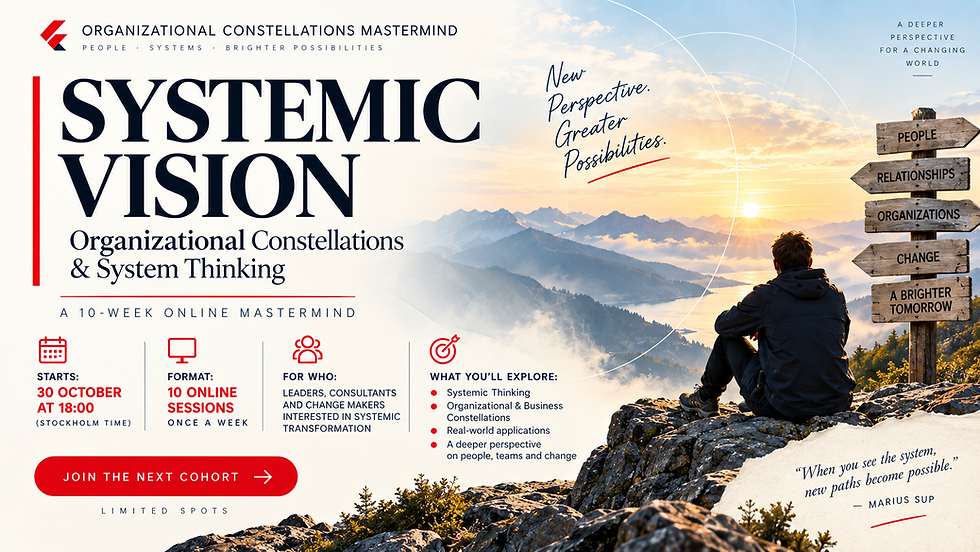
If you want to explore Systemic Thinking and Organizational & Business Constellations at a deeper level, the next Systemic Vision Mastermind starts October 30.
Reply “VISION” or send me a message and I’ll send you the details.


Comments