Why smart people keep solving the same problem


There is something fascinating about intelligent people: they are usually very good at solving problems. They analyse, they learn, they gather information, they look for patterns, they create strategies, they try something different, and when something doesn't work, they often go back and try again with even more effort. Yet sometimes, despite all this intelligence, experience and effort, they find themselves facing the same problem again and again. The people may be different, the circumstances may have changed, the strategy may have been replaced, but somehow the outcome keeps looking strangely familiar.
You may have experienced this yourself. You have a difficult conversation with someone, you solve it, and a few months later you find yourself having almost the same conversation with someone else. You change a person in your team, but the same tension appears with the next person. You change your business strategy, but the same stagnation returns. You work harder, communicate more clearly, introduce a new process, hire someone new, set different goals, and for a while things seem to improve ....until, somehow, you are back in a very similar place.
At that point, it is tempting to ask: What am I doing wrong?
But perhaps that is not always the most useful question.
Perhaps the more interesting question is: What if the problem is not only in what we are doing, but in the system in which we are doing it?
This is one of the shifts that attracted me to Systemic Thinking. When we look at a problem, we naturally tend to focus on the most visible element: the person, the decision, the behaviour, the process, the strategy or the event that appears to have caused the problem. We try to fix that element, because it is concrete and easier to work with. But a system is not made of isolated elements. It is made of relationships, roles, expectations, patterns, feedback loops, boundaries, histories and often unspoken rules that influence how everything else behaves.
Imagine a team where communication keeps breaking down. The obvious solution might be to improve communication: have another meeting, introduce a new communication process, clarify responsibilities or send another email explaining what everyone should do. All of these things might be useful, but what if the communication problem is actually connected to something else? Perhaps two people have overlapping authority. Perhaps someone has influence without having a formal role. Perhaps an important decision is being avoided. Perhaps the team has learned that speaking openly creates consequences, so people have become careful about what they say. Perhaps something from the past has never really been acknowledged.
You can keep improving the communication and still be solving the wrong problem.
This is why systemic work starts to become interesting when a pattern repeats. Repetition is information.
When the same type of situation keeps appearing with different people, different projects or different circumstances, it may be worth looking beyond the individual event and asking what remains constant. What is the structure underneath the situation? What relationships continue to reproduce the same outcome? What role are you playing within the pattern? What is being rewarded? What is being avoided? Who or what is missing from the picture? What assumptions have become so normal that nobody questions them anymore?
Sometimes we change the people but not the system, and then we are surprised when the pattern comes back.
A manager leaves and another manager arrives, but the same conflict develops. A client relationship ends and a new client arrives, but somehow the same dynamic appears again. A founder changes the strategy, changes the team and changes the business model, but continues to experience the same pressure. We may think we are dealing with a new situation, while the system is quietly reproducing something familiar.
And this is where intelligence alone may not be enough.
Because intelligence is very good at analysing what is visible. It can help us find solutions, compare options, understand causes and make better decisions. But sometimes the thing we need is not another solution. Sometimes we need a different position from which to see the problem.
Instead of asking only, “How do I solve this?”, we can ask, “What is this situation connected to?”
Instead of asking, “Who is causing the problem?”, we can ask, “What happens between the people involved?”
Instead of asking, “Why isn't this person changing?”, we can ask, “What in the system might be maintaining the current behaviour?”
And instead of asking, “What should we do next?”, we can sometimes begin with a simpler question:
“What are we not seeing?”
That question can create a completely different conversation.
This is also why I believe systemic mapping can be so powerful. When you take something that has been living only inside your head and make the elements visible — the people, roles, relationships, goals, tensions, resources, expectations and other relevant parts of the situation — you can sometimes see something that was almost impossible to see while everything existed only as thoughts.
You might suddenly notice that the person you considered the problem is actually positioned between two conflicting expectations. You might see that a decision is sitting too far away from the person who has the responsibility for it. You might notice that something important has been left outside the system. Or you might discover that you have been standing in a position where you are constantly trying to compensate for something the system itself is not addressing.
The map does not give you the answer.
It gives you new information.
And sometimes new information is exactly what is needed to stop repeating an old solution.
I think this is one of the reasons systemic work can be particularly valuable for coaches, consultants, facilitators, leaders and professionals who work with people and organizations. You are often already very good at listening, questioning, analysing and helping others move forward. Systemic Thinking does not need to replace those skills. It can add another lens — one that helps you notice the relationships and patterns surrounding the individual or problem you are working with.
Because sometimes the smartest thing you can do is not become better at solving the same problem.
It is to stop and ask whether you are looking at the right system.
If you keep getting different versions of the same result, perhaps the question is no longer “What should I do differently?”
Perhaps it is:
“What needs to be seen differently?”
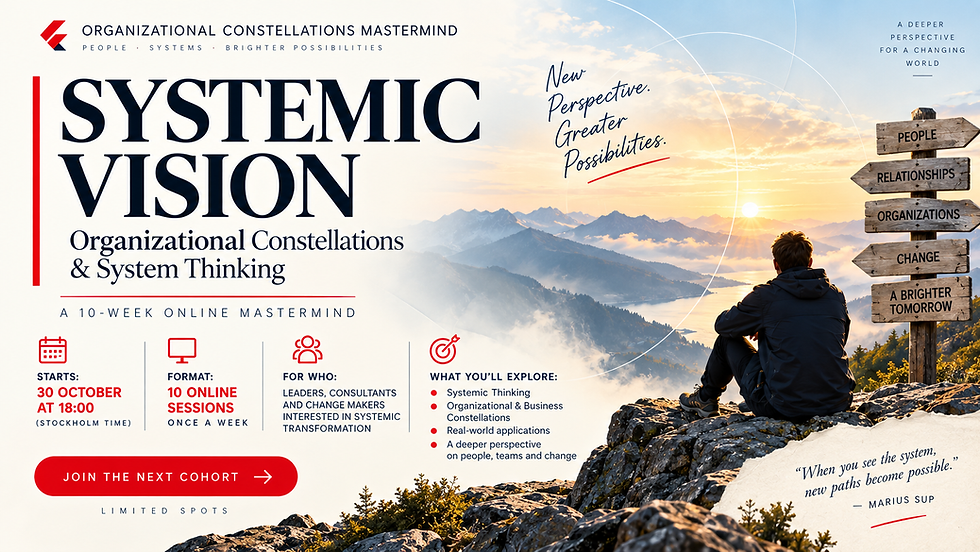
If you want to explore Systemic Thinking and Organizational & Business Constellations at a deeper level, the next Systemic Vision Mastermind starts October 30.


Comments